
In this case study
The busiest hours were the hardest to answer.
Casa Dorado Restaurant Group operated 14 locations: four fine-dining restaurants, seven casual-dining restaurants, and three fast-casual outlets. Reservations, takeout orders, catering inquiries, and everyday questions arrived in English and Spanish while staff were serving guests.
The project’s customer snapshot reported that 41% of inbound inquiries went unanswered. Every missed call could mean a lost reservation, an abandoned order, or another interruption for the team trying to call back.
For the customer
A simple question or reservation depended on someone being free to pick up. During peak service, the next step could become voicemail or trying another restaurant.
For the restaurant
The same staff had to look after guests and answer the phone. Growing demand stretched that operating model across every location.
The design challenge
How might we respond to customers immediately without adding more work for the people serving them?
XBert needed to handle routine requests and involve staff when needed. Just as importantly, owners needed a way to set it up and manage it without technical expertise.
Connect the call data to the work on the floor.
Discovery combined a 30-day call audit, host-stand shadowing, guest interviews, and competitive analysis. Together, these methods connected call patterns with operational bottlenecks and customer expectations.
| Research method | What it helped us understand |
|---|---|
| 30-day call audit | Call volume and patterns: when demand arrived and where coverage broke down. |
| Host-stand shadowing | How phone calls competed with in-person service during busy periods. |
| Guest interviews | What customers expected when contacting the restaurant. |
| Competitive analysis | How existing solutions approached customer communication. |
Three insights shaped the priorities.
Peak demand created peak failure.
The dinner rush brought the highest call volume at the same time staff were busiest with guests.
Much of the work was predictable.
Table availability, reservations, opening hours, and takeout requests repeated across calls.
Coverage had to work in two languages.
English and Spanish were part of the restaurant group’s everyday service needs.
Owners needed confidence before launch.
The brief called for setup and management without technical expertise.
Answer routine questions, support both languages, and make escalation part of the service. The aim was reliable coverage that owners could understand and manage.
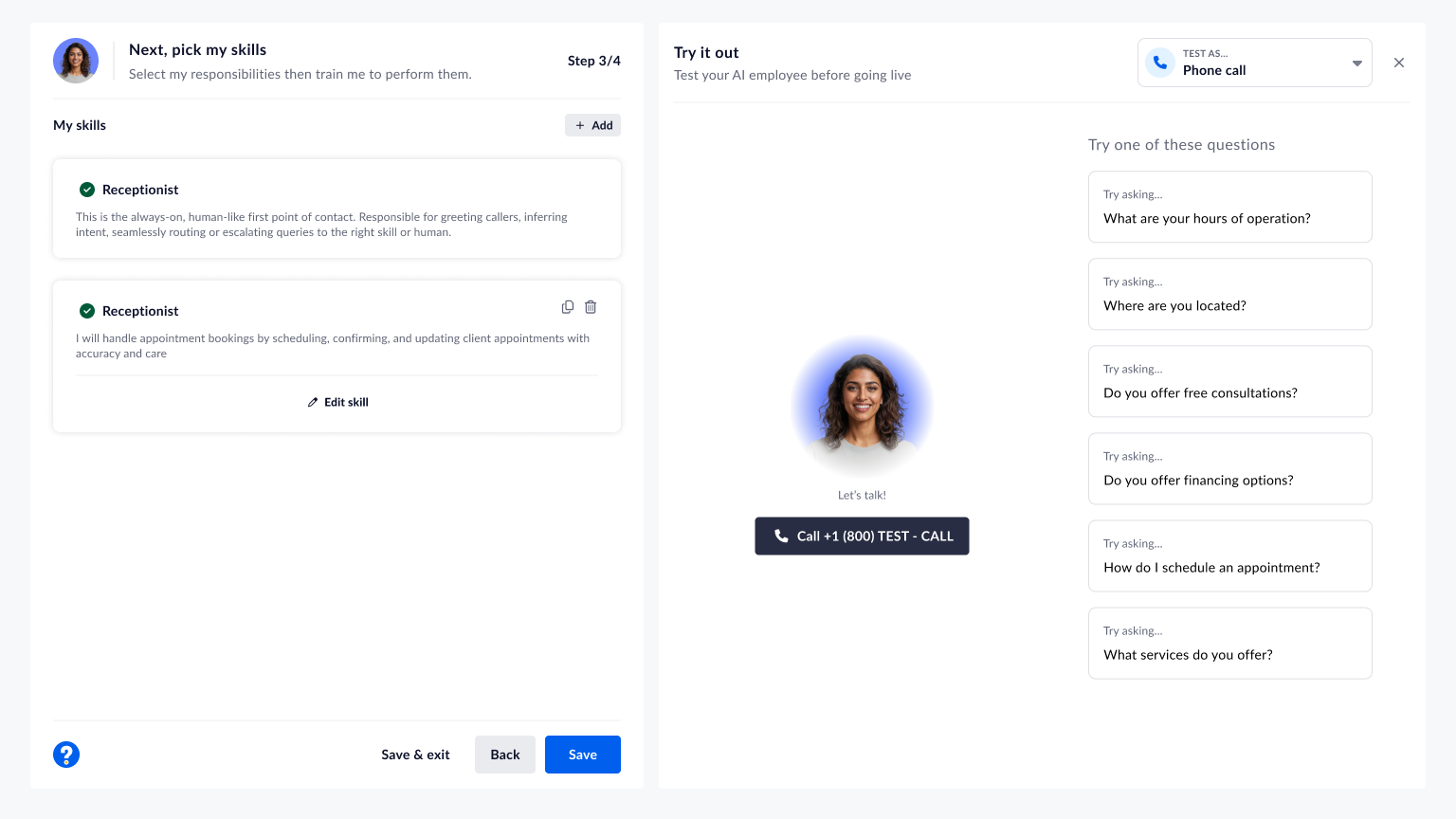
Make the AI’s responsibilities visible before it goes live.
The onboarding experience breaks the work into understandable choices: how XBert represents the business, what it can do, and when it answers. These three decisions connect the restaurant’s needs to the product screens.
Make the AI’s behavior a business choice.
The first setup step brings voice, languages, personality, and greeting together. A business can choose how the AI represents it before assigning responsibilities.
- Design rationale
- Voice, language, and greeting shape the first customer interaction. Bringing them together gives owners a clear place to define that experience.
- Tradeoff
- More configuration creates more decisions. Grouping related choices into one step keeps the task bounded.
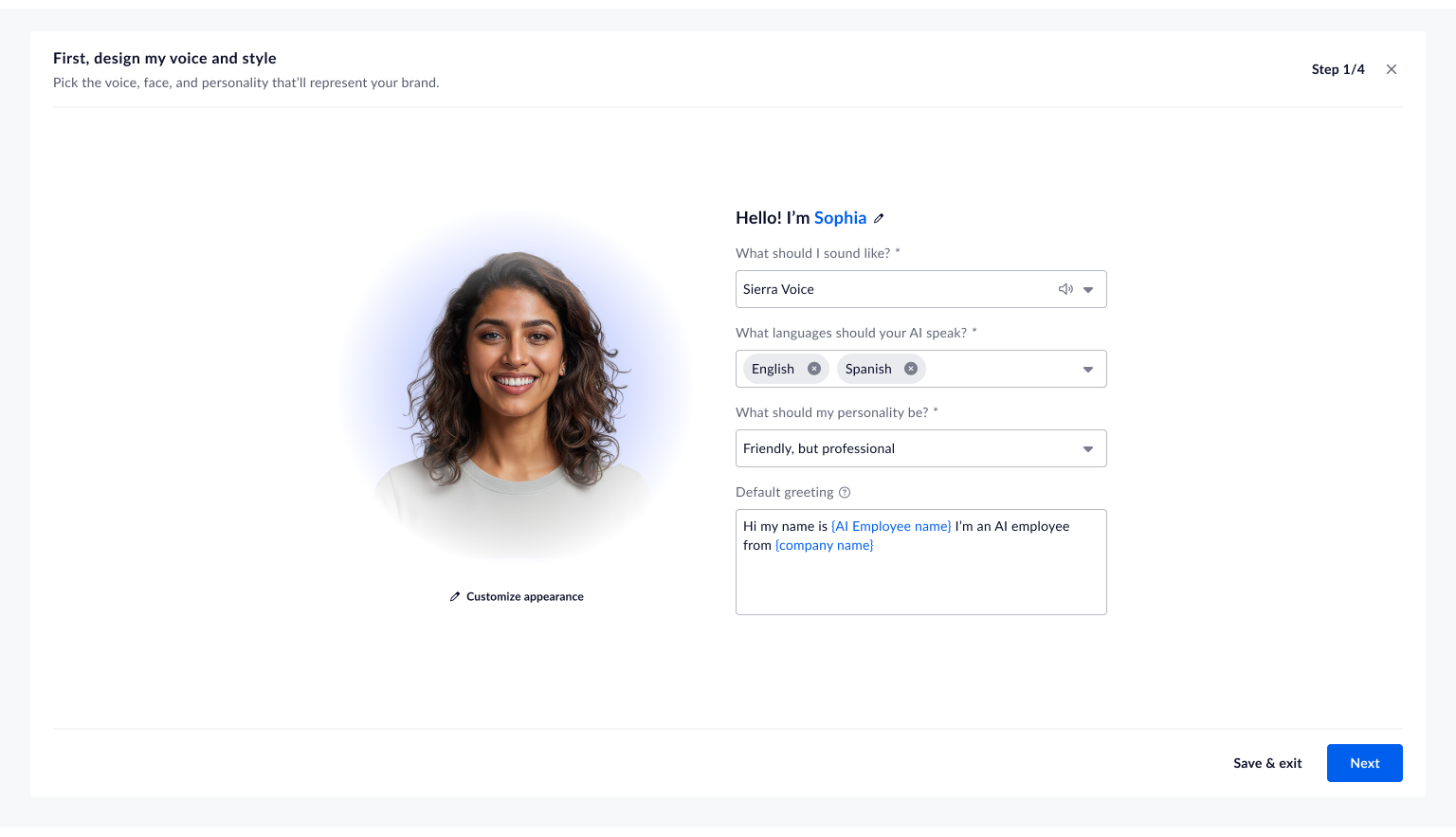
Choose voice, language, and greeting together.
The greeting explicitly identifies the speaker as an AI employee. English and Spanish are visible selections rather than hidden assumptions.
Describe work as skills, not an open-ended promise.
The skill picker presents tasks owners recognize, including FAQs, appointments, and takeout orders. Required apps are shown on the cards so a capability’s dependencies are visible when it is selected.
- Design rationale
- A skill catalog turns a broad promise of AI assistance into tasks the business recognizes. Owners can see what they are enabling and which applications it requires.
- Tradeoff
- A growing catalog adds selection effort. Search, an industry filter, and dependency labels help organize that complexity.
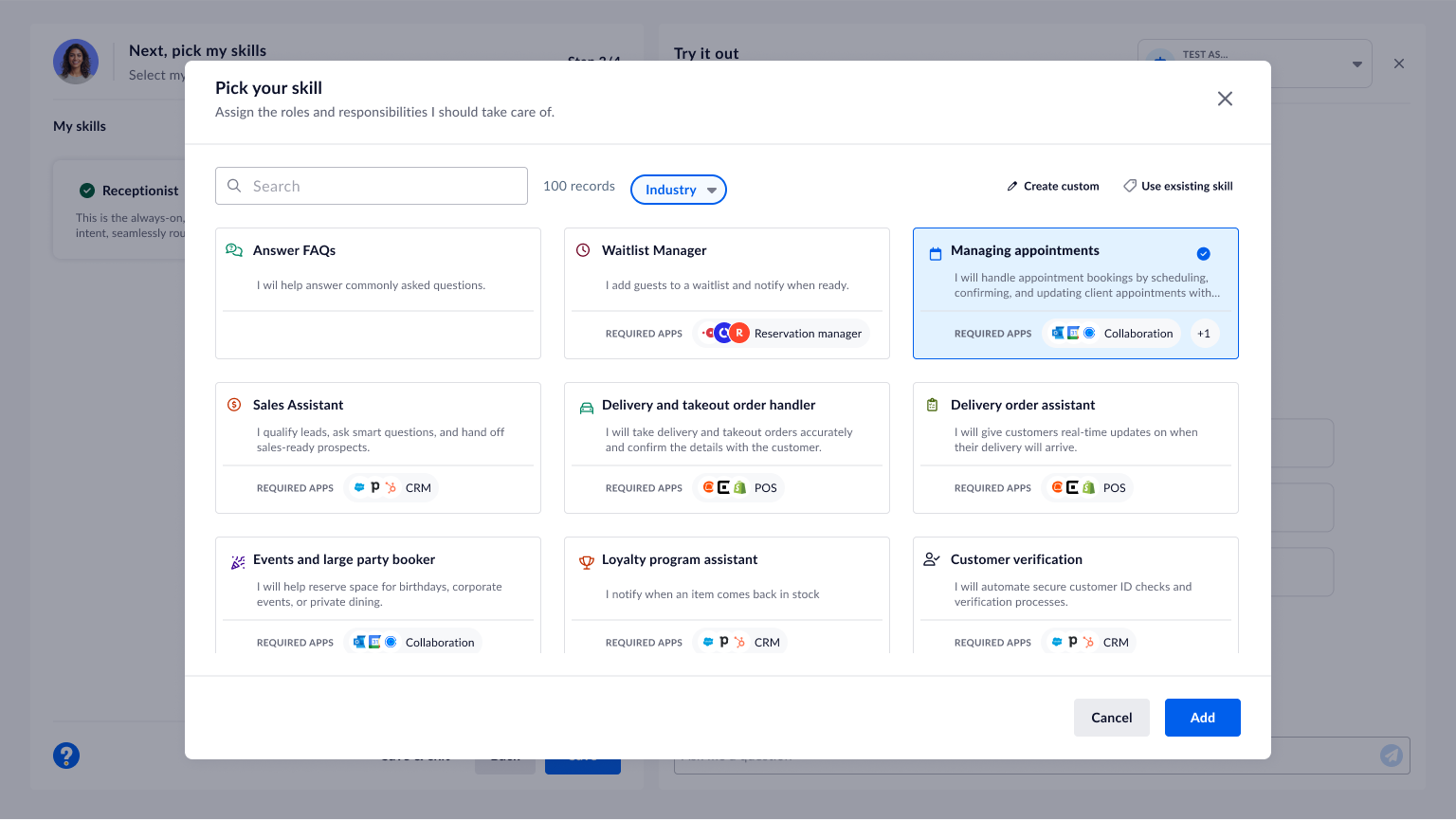
Select the task and understand what it depends on.
The library pairs business responsibilities with required applications. Custom and existing-skill options appear alongside the catalog.
Let owners inspect behavior while configuring coverage.
The final setup view places inbox, schedule, and call-answering settings beside a chat test. Owners can see the customer-facing reply and inspect the AI’s actions in a separate panel.
- Design rationale
- Keeping testing beside configuration shortens the path from changing a setting to observing the result. Owners can inspect both the reply and the actions behind it.
- Tradeoff
- The split view is denser. Separating the customer reply from the owner-only action panel keeps operational detail out of the conversation itself.
- What this enables
- Owners can compare a configuration choice with the resulting test response and inspect the actions behind it before launch.
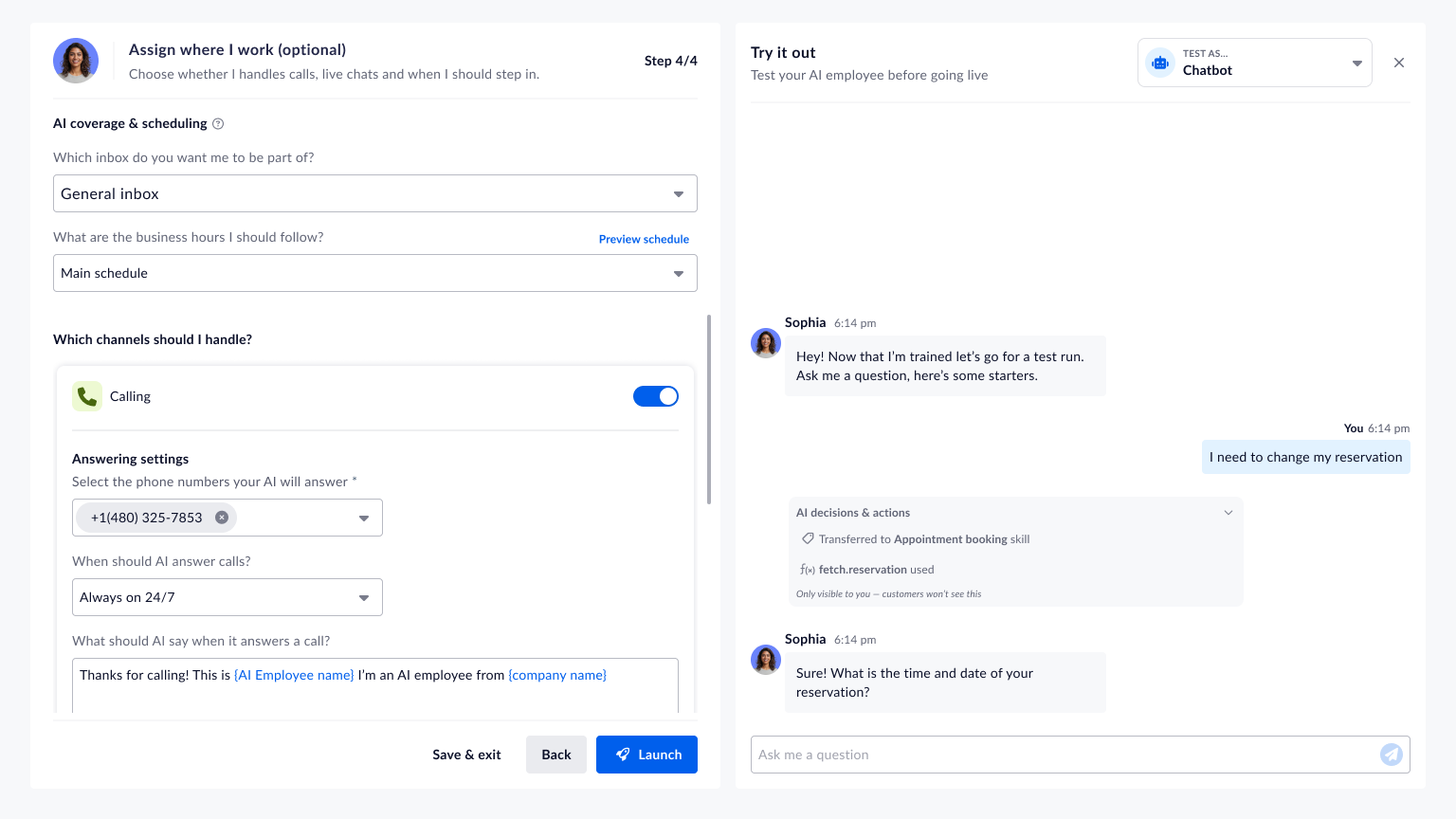
Make actions inspectable without exposing them to the customer.
The test shows a transfer to an appointment-booking skill and a reservation lookup. The action panel makes the skill transfer and lookup visible to the owner.
Two connected journeys: the owner and the caller.
The owner configures the service; the customer experiences it in a conversation. Keeping those journeys connected makes coverage, capabilities, and escalation part of the same product story.
The owner: configure, test, launch.
- 01Define identity
- 02Assign skills
- 03Test behavior
- 04Set coverage & launch
This summarizes the setup surfaces shown above. Language, selected skills, connected applications, and answering schedules define the service the owner intends to offer.
The caller: get an answer and a next step.
- XBert answers and understands the request.The service is designed for immediate responses, including English and Spanish conversations.
- A relevant skill handles the routine task.Reservations, takeout, FAQs, and catering inquiries are the core restaurant use cases described in the project.
- Staff take over when the request needs a person.The service model includes transferring complex requests with conversation context so staff can continue the interaction.
XBert handles routine work; owners define its responsibilities and coverage. Complex requests have a path to staff. The supplied interface screens show setup and testing; the staff’s receiving experience is outside this walkthrough.
Make behavior testable before customers depend on it.
The pre-launch experience supports phone and chat testing, suggested questions, and an owner-only view of AI actions. That lets an owner examine more than whether a reply sounds natural: they can check whether XBert used the expected skill and business information.
What the next validation round should establish
The following is a proposed validation plan, organized around the moments most likely to affect trust and service quality.
| Scenario to test | Success signal |
|---|---|
| An owner sets busy-hour or after-hours coverage. | They can explain when XBert will answer and correctly configure that behavior without help. |
| A caller asks a routine question in English or Spanish. | The response uses the intended language and the correct business information. |
| A booking lookup fails or an integration is unavailable. | The conversation communicates the failure and offers a useful next step without claiming a booking succeeded. |
| A request requires staff, but nobody is available. | The caller knows what happens next, and the request can be recovered with its context. |
| The owner spots an incorrect answer. | They can find the relevant setting or knowledge, correct it, and retest the behavior. |
The project material documents discovery, product capabilities, and reported business outcomes. It does not supply participant-level usability results or a verified before-and-after design iteration. The scenarios above are next steps, not completed study findings.
Better coverage. More time for guests.
Fewer missed calls
The project reports improved answer rates, more bookings captured, and less routine call handling for staff. The eight-month project delivered XBert across NEXT, NCX, and N1.
| Before XBert | Reported after XBert |
|---|---|
| 41% of inbound inquiries unanswered | Up to 50% fewer missed calls |
| Staff split between calls and guests | AI handles routine inquiries, reducing call-handling workload |
| Missed reservation opportunities | More bookings captured |
| Coverage constrained by staff availability | 24/7 response capability and simultaneous conversations |
Source: the supplied XBert project deck, customer snapshot and results sections. These are reported outcomes, not independently verified measurements. The deck does not specify a post-launch measurement window or sample size; the 50% figure is a reduction in missed calls, not a 50-percentage-point change in answer rate.
What I take forward
Design the owner’s confidence, too.
A natural conversation is only one part of an AI service. Clear setup, explicit responsibilities, and inspectable actions help the business understand what it is putting in front of customers.
Treat response time as part of the service.
For a restaurant, availability affects reservations and staff attention. The design has to connect customer convenience with the practical rhythm of the business.
Make correction and recovery the next priority.
I would deepen the experience for correcting business knowledge, recovering from failed actions, and receiving escalations. Those moments determine whether staff can rely on the service when a conversation becomes difficult.